

APEXTRACE · DEVLOG
Why are you losing time in GT7: braking, cornering or acceleration?
Improve your GT7 lap times by finding losses under braking, through corners and on exit. Compare your laps and test one change at a time.
· AdminA real GT7 comparison: Sardegna B
You complete another lap in Gran Turismo 7. No spins, no trips off track, and almost the same line as the faster ghost. Yet you are still behind at the finish. Braking later makes the lap feel more intense, but the stopwatch barely changes.
To improve your lap time in GT7, break down one complete corner: how you slow down, how you pass through its middle, and how much speed you carry onto the next straight. An entry mistake may only become obvious under acceleration.
Start with a fair comparison
Two of your own laps are a good starting point: a typical lap and a faster one. You do not need to compare yourself with the world leaderboard leader straight away.
Use the same car, circuit layout and comparable conditions. Tyres, fuel, setup, driving assists, slipstream and track conditions can affect the result. If you change your technique and your car at the same time, it becomes harder to explain any improvement.
Choose one corner and a reference point beyond it, such as a board before the next braking zone. Assess the whole section up to that point. A gain at the apex can still become a loss on the straight.
Braking: later is not always faster
If you brake too early or for too long, you may slow the car more than necessary. There is still distance to cover before the corner, but you have already lost speed.
The opposite will probably sound familiar too: you delay braking and close on the ghost, but fail to prepare the car for the turn. You run wider, spend longer turning and have to wait before accelerating.
So look beyond the start of braking. Your approach speed, the duration of deceleration and how you release the brake on entry all matter. Trail braking means gradually reducing braking as you begin to turn, and it needs to work together with steering. The same approach will not suit every car and corner.
Try this: keep your familiar braking marker and work on a more controlled brake release. In a separate run, test a small change to the braking point. Compare the result at your reference point beyond the corner. Do not change both actions at once.
Mid-corner: a higher speedometer reading is not automatically a gain
Sometimes the car enters quickly but does not reach a position from which you can accelerate well. You add steering, wait for it to turn or correct the line.
Check three things: where you reach minimum speed, which way the car is pointing there, and how long it takes before you can accelerate confidently. If you use a controller, the same questions apply to your stick and trigger inputs.
Do not chase a higher minimum speed at any cost. Before a long straight, a calmer entry can produce a better exit. In a sequence of corners, you also need to consider the next turn.
Try this: reduce your entry speed slightly while keeping other conditions unchanged. See whether you can complete the section with fewer corrections and position the car better for acceleration. Compare the time through the whole section, not just how fast its middle feels.
Acceleration: early throttle helps when you can keep it applied
Imagine the ghost is still alongside at the apex, then starts pulling away. By the end of the straight, the gap is obvious.
First check your exit from the previous corner. Even at full throttle, a lower starting speed can allow the gap to keep growing. Losing time on a straight does not, by itself, prove that you lack power.
Early throttle can also force another lift if the car runs wide or loses grip. The first moment you apply the throttle tells you little on its own. Watch how speed builds afterwards and whether you have to release the pedal or trigger again.
Try this: add throttle as the car allows you to straighten the line. Compare speed at the same point after the exit. Aim for acceleration you can sustain without forced corrections.
How to see your inputs instead of trying to remember them
You can start with a replay and a ghost comparison. The next step is to look at a recording of speed, throttle and brake inputs.
GT7 on PS5 can send driving data over your home network. ApexTrace receives it on a Windows 10/11 PC and saves your laps. The game continues to run on the console; you do not need a capture card to record telemetry.
In the application, you can select two recorded laps and compare their speed, braking, throttle and racing lines. The time-delta graph helps you locate the section where their results start to diverge.
Find that section first, then look at what happened before it. If the gap grows on exit, go back to corner entry: the cause may have appeared earlier. The graphs show differences between runs; your explanation of those differences needs testing on the next attempt.
You can also open a published session in a browser, including on a phone, to inspect an individual lap. A/B comparison of two laps takes place in the Windows application.
One practice session, one question
Choose a familiar car and one corner. Drive several laps under the same conditions and save your baseline result.
Set a specific test: “If I finish the main deceleration slightly earlier, can I get a better exit onto the straight?” Change only that action, repeat several attempts and compare the section up to the same reference point.
Pay attention to repeatability too. A technique you can use consistently is more useful than one lucky attempt you cannot yet reproduce.
For your next run, one clear observation is enough: where the loss develops, which action you will change and how you will check the result. The ApexTrace guide explains how to set up recording from your PS5.
A real GT7 comparison: Sardegna B
ELANTRA N TC ’24 · 17 October 2026. These are complete laps 1 and 5 from one recording in the ApexTrace desktop app. A takes 1:30.358; B takes 1:30.839, 0.481 s slower.
A · Lap 11:30.358
B · Lap 51:30.839
Over the selected 2600–3100 m section, A takes about 12.874 s and B 13.312 s. B loses approximately 0.438 s through this corner and the following acceleration zone.
At 2700 m, A travels at 112.9 km/h and B at 95.5 km/h. At 2660–2680 m, A is already at full throttle while B has released the brake but has not yet reapplied the throttle. By 3100 m the speed gap is only 1.2 km/h, but the time lost remains. This suggests checking the transition from braking to acceleration, not simply pressing the throttle harder.
━━ A · Lap 1┄┄ B · Lap 5
Horizontal axis: metres along lap A’s recorded path, starting at its first sample. Both traces use the same spatial reference.
| m | A · km/h | B · km/h |
|---|---|---|
| 2600 | 135.8 | 135.1 |
| 2700 | 112.9 | 95.5 |
| 2800 | 135.6 | 127.9 |
| 3100 | 170.9 | 169.7 |
What to try in your next run
Keep the car, setup, assists and conditions unchanged. Change only one part of the corner: for example, how smoothly you release the brake. Compare several complete laps at the same positions. Check the time through the whole section and speed further down the straight before deciding whether the change helped.
How this example was measured
Full-resolution desktop recording, nominally 60 Hz: 5378 samples for A and 5390 for B. B’s x/z positions are projected onto A’s path and interpolated linearly. The section boundaries are editorial checkpoints, not official GT7 sectors. Maximum lateral separation within this section is about 5.4 m.
Tyre, setup, assist and traffic equality is not established. These two laps show an observation, not a controlled experiment or a guaranteed gain. The English screenshots below show the actual app; its comparison uses distance fraction, while the article charts above use shared spatial positions. The app displays Δ A−B.
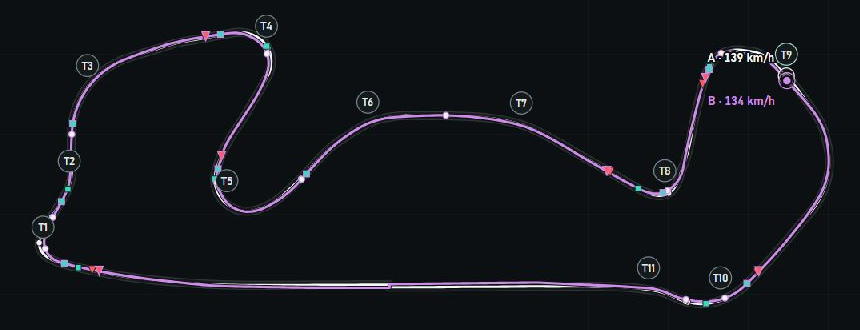
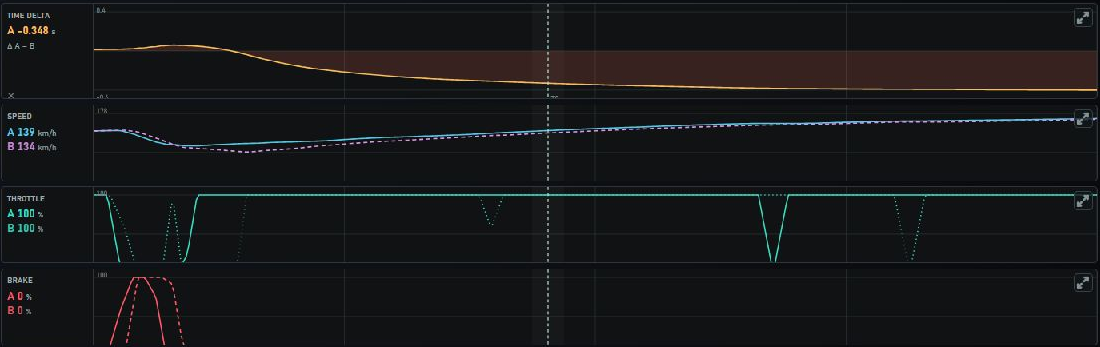
ApexTrace — GT7 telemetry for Windows — The official application site by Farodin Projects: features, download and setup.
Comments
Sign in